
BOOKS
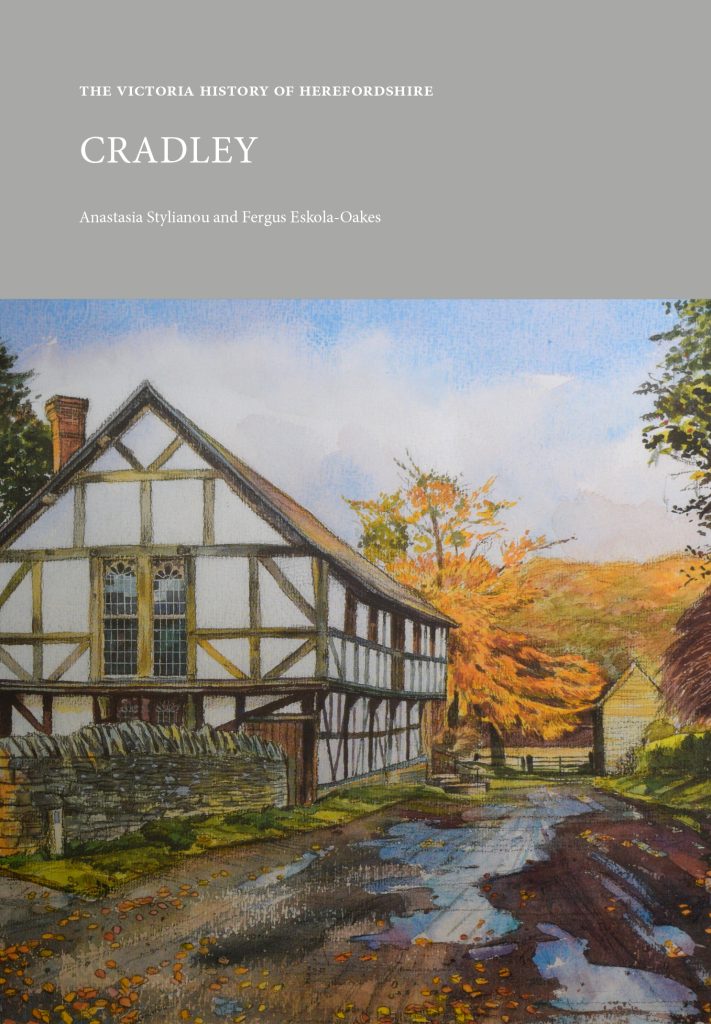
Scenic and rural, the parish of Cradley stretches down westwards from the Malvern Hills, bordered by Worcestershire to the north and east. It is one of the largest parishes in Herefordshire, and from the medieval period to the nineteenth century was populous and prosperous. Cradley manor was a valuable holding of the medieval bishops of Hereford. The ecclesiastical benefice, Anglo-Saxon in origin, was equally lucrative, frequently passing nepotistically to well-connected young priests; however, such connections did not prevent one thirteenth-century rector being outlawed for murder! The expanding number of manors in the parish, from the thirteenth century onwards, resulted in a fragmented model of land ownership and the development of a powerful body of wealthy yeomanry, shaping the distinctive character of the parish and its governance in the early modern period.
Drawing extensively on local archival sources, this volume analyses, among other topics, the centrality of agriculture to the parish’s story, charting Cradley’s socio-economic growth from the sixteenth to nineteenth centuries, before its subsequent decline. As such, this book constitutes an important contribution to English local history, exploring the prosperity that could be enjoyed by parishes in fertile Eastern Herefordshire, and the impact of changes in the national economy upon rural, agrarian communities.
(Under contract with Routledge) Anastasia Stylianou,The Invisible Greeks: English Encounters with the Greek East, 1450-1700.
The Invisible Greeks argues that early modern contacts between ‘the Greeks’ and ‘the English’ significantly shaped the course of England’s history. This is demonstrated with reference to the impact of Greek migration, the role of Greek individuals in the development of English humanism, Hellenic influences on the English Reformations, and the fruits of English travellers’ encounters with Greek communities in Italy and the Ottoman Empire.
The study is the first to explore how, over the period 1450-1700, early modern English contacts with Greek communities in the Mediterranean and Middle East so influenced the development of English identity that, by 1700, many aspects of English life had significant Hellenic foundations. This applies to the structure and theology of the Church of England, to the themes pervading English literature, art and music, to the dominant role the Classical Greek language played in elite men’s education, or even to the growing popularity of coffee and coffee houses. This book also analyses how it was that the English so quickly forgot the impact of contacts with early modern Greeks, and came to see these cultural developments as a quintessential part of ‘Englishness’. Invisible Greeks, thus, demonstrates the enduring impact upon British culture and consumption of early modern connections with the Mediterranean and Middle East, as well as highlighting the profound influence of even numerically-small minority groups upon a country’s evolution.
PEER-REVIEWED JOURNAL ARTICLES AND BOOK CHAPTERS
‘“We are at the furthest part of the inhabited world”: Venetian Greeks and the English Reformations’, Studies in Church History 61 (2025), 360-383.
This article examines encounters between Venetian Greeks and English reformers, c.1545–c.1700, focusing on two figures, Andronikos Noukios alias Nikandros (c.1500–c.1556) and Kyrillos Loukaris (1572–1638), and their textual afterlives. It is the first study to examine the role the Venetian empire played in Greek Orthodox contacts with the Church of England during the early modern period. In doing so, it takes an under-utilized approach to studying early modern encounters between Eastern and Western Christianities, bringing the field of religious history into direct dialogue with that of bibliographical history to extend our understanding of the long-term intellectual and religious impact of specific episodes of encounter. It argues that Anglo-Hellenic religious contacts were shaped by a shared sense of operating on the peripheries of power, but also limited by the mutual perception of the other as intriguing but inferior, or of marginal importance.
Early modern Anglo-Hellenic relations have received little scholarly attention; however, Greek Christianity had a significant influence on the English Reformations. This article analyzes sixteenth-century English textual contacts with, and constructions of, Greek Christianity. It highlights the importance of Greek Christian history (from the patristic era to the fall of Constantinople) to reformers across the confessional spectrum, and investigates the various uses of this history in justifying or criticizing England’s break with Rome, focusing upon the government’s propaganda tracts of the 1530s, Reginald Pole’s De Unitate, and John Foxe’s Acts and Monuments. It also examines the Venetian-Greek Nicander Nucius’s depiction of the Henrician Reformation in his autobiography, exploring how this unique account was shaped by Nicander’s religious beliefs. Eastern Christianity must be incorporated into historical narratives of the English Reformations in order to understand fully the confessional debates, encounters, and identities of the period.
This chapter examines the reception of classical constructions of bodily fluids, especially blood, in Medieval and Early Modern martyrologies. It analyses how the martyrologists employed classical medical thought and early Church beliefs in response to their own concerns. New Testament depictions of blood and martyrdom and the discourses of martyrs’ blood found in early-Church writers, such as Origen and Tertullian, were the foundations upon which later martyrologists built. They employed and adapted this heritage to suit present concerns. Reformation martyrologists utilised martyrs’ blood as a polemic weapon, rival confessions seeking to align themselves with what they portrayed as early-Church precedent. At the root of these divergences lay fierce disagreement over the exact nature of early Church theology of the martyr’s body, a perspective this chapter will open up. In contrast to this overt engagement with early-Church sources, classical medicine is usually only implicitly present in Medieval and Early Modern martyrologies. Nonetheless, analysis of their use of classical medical thought offers valuable insights into changing theologies of the body. Medieval martyrologies drew upon classical medical thought in constructing the martyr’s body as spiritually fertile and as miraculous, for example depicting martyrs ‘bleeding’ milk. As the spectacularly miraculous disappeared from Early Modern martyrology, so too did many echoes of classical medicine. Some remained, however, both in metaphors emphasising the life-giving nature of martyrdom—such as imagery of martyrs’ blood as milk, sperm, or maternal blood—and in paralleling of blood and tears. The Medieval and Early Modern sources examined in this chapter include three popular Medieval hagiographical compilations (Jacobus de Voragine’s Golden Legend (c. 1260), John Mirk’s Festial (c. 1380s), the anonymous fifteenth-century Speculum Sacerdotale, works by the leading English Protestant martyrologists John Bale and John Foxe, and texts by key English Catholic apologists, such as William Allen and Robert Parsons.
‘Martyrs’ Blood in the English Reformations’, British Catholic History (2017), vol. 33 (4), 534-560.
Protestant and Catholic martyrologies evolved in dialogue; however, they did not articulate a common conception of martyrdom. Viewing Protestant and Catholic martyrologies and notions of martyrdom as essentially similar obscures highly significant confessional differences, which generated fiercely opposed constructions of martyrdom. This argument is examined through an analysis of the treatment of martyrs’ blood in English martyrological texts, since this encapsulated core confessional theologies.
(Under contract) ‘Conflict, Migration, and Identity in the Autobiographical Writings of Christophoros Angelos and Nikandros Noukios, 1545-1620’, in Warren Boutcher (ed.), Europe in the World: A Literary History, 1529-1683 (Oxford University Press).
BOOK REVIEWS
OTHER
‘The English Reformations’, Modern History Review [magazine for A-level students], vol. 22 (September 2019).